AdaMAST concepts
This page defines the vocabulary the rest of the documentation uses. Read it once before the integration guides; every other page assumes these terms.
AdaMAST is not another task solver. It is a runtime supervision layer that gives an agent a structured way to ask, "what mistake am I about to repeat?" — and a learning loop that turns completed runs into a failure-mode taxonomy specialized to your tasks.
The runtime loop
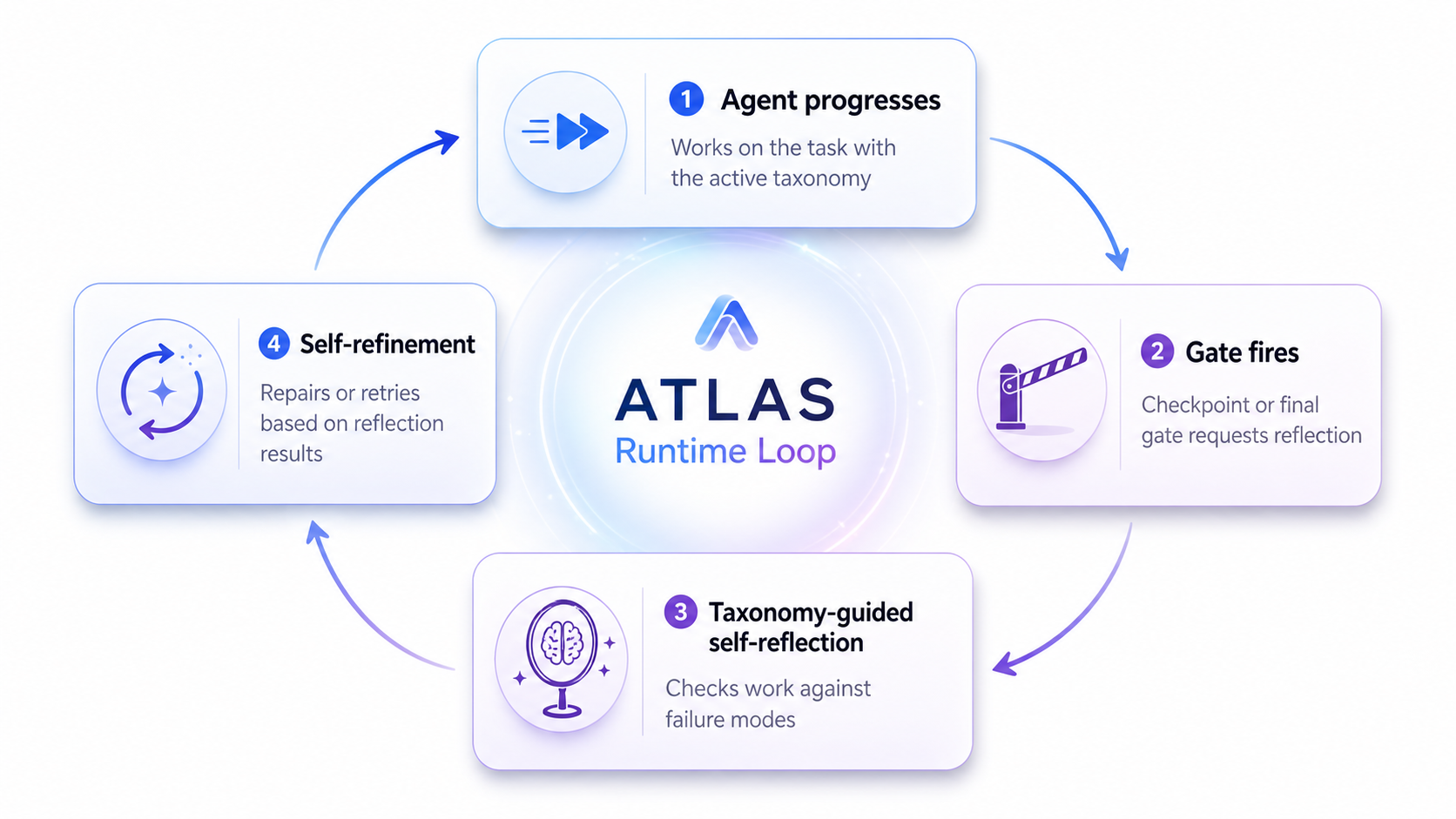
- A task starts. AdaMAST selects the active taxonomy: an inherited stored taxonomy if one is configured, otherwise the built-in MAST fallback.
- At configured boundaries (checkpoints, tool failures, subagent stops), the agent is asked to reflect on its recent trajectory against the taxonomy.
- Before the final answer is released, a pre-submission gate requires a structured reflection; the agent gets a bounded number of repair attempts.
- At session end, one canonical trace of the task is recorded.
- When enough traces accumulate, AdaMAST generates a task-specific taxonomy (from MAST warm-up) or refines the active stored taxonomy. Accepted results become stored taxonomies that future runs can inherit.
Key terms
| Term | Meaning |
|---|---|
| Program | One learning stream, identified by its trace_output folder. Reusing the same trace_output means "same program": counters, pending traces, and the active taxonomy are shared. |
| Taxonomy | A JSON record of failure-mode codes, selected only by taxonomy_id. repo and domain are display metadata and route nothing. |
| Code | One failure mode inside a taxonomy: an id, an observable name, and a task-neutral diagnostic description. |
| Gate / checkpoint | A configured boundary where the agent must reflect before continuing. The final submission gate is the blocking one; others are advisory nudges. |
| Reflection | The required response shape at a gate: Observe → Correlate → Map → Decide. none apply is a valid outcome; codes fire only when evidence supports the match. |
| Trace | The canonical record of one completed task (task text, redacted trajectory, metadata). Traces are the input to generation and refinement. |
| Runtime evidence | Per-checkpoint firings and clean reflections recorded while a task runs. This is what the dashboard displays. |
| Generation | The MAST → stored-taxonomy transition. Fires after generation_threshold warm-up traces; the candidate must pass the Reflection Judge unless skip_judge is set. |
| Refinement | Periodic improvement of an active stored taxonomy, after k_init traces first and every k traces thereafter. Accepted refinements get a new taxonomy_id. |
| Lineage | The successor link from a refined taxonomy to its replacement, so evolution history is preserved across programs. |
| Inheritance | Starting a run from a stored taxonomy via --inherit <taxonomy_id> or the interactive picker. No inherit value means "start from MAST". |
The reflection shape
Every gate asks for the same four steps, in order:
- Observe concrete events or missing expected steps in the recent trajectory.
- Correlate only evidence-supported causes.
- Map to taxonomy codes only when the evidence supports the match.
- Decide whether to make one focused repair or continue.
A reflection that maps no codes is a clean checkpoint and is recorded as evidence too. Agents must not invent a failure mode to satisfy the gate.
Decisions that would replace an already-committed answer are additionally held to a replacement standard: the agent must construct and run a check that demonstrates the current answer's failure (internal, source, task-constraint, or completeness consistency) — an alternative's appeal alone never authorizes a replacement.
Built-in MAST
MAST is the Multi-Agent System failure Taxonomy from "Why Do Multi-Agent LLM Systems Fail?" (Cemri et al., 2025). AdaMAST ships a 14-code adaptation as its zero-configuration starting point: when no taxonomy is inherited, runs begin with these codes and MAST warm-up traces feed the first generation.
| Category | Codes |
|---|---|
| Specification | MAST-1 Disobedient to task specification · MAST-2 Disobedient to role specification · MAST-3 Step repetition · MAST-4 Loss of conversation history · MAST-5 Unaware of termination conditions |
| Coordination | MAST-6 Conversation reset · MAST-7 Failure to ask for clarification · MAST-8 Task derailment · MAST-9 Information withholding · MAST-10 Ignored other agent's input |
| Verification | MAST-11 Premature termination · MAST-12 No or incomplete verification · MAST-13 Weak verification · MAST-14 Incorrect verification |
The full definitions live in finding/mast.json.
MAST is a built-in constant, not a store record; it does not appear in the
interactive picker.
What AdaMAST is not
- Not a task solver, planner, or wrapper around your agent's model calls — your harness owns model execution.
- Not a static linter: codes fire from evidence in the live trajectory, not from source analysis.
- Not a router:
repoanddomainnever select taxonomies; onlytaxonomy_iddoes.
Where to go next
- First run: GETTING_STARTED.md
- Every config field: CONFIGURATION.md
- The learning lifecycle in detail: TRACES_AND_LEARNING.md
- Writing your own harness: INTEGRATION.md