An example run
This page shows what the agent actually sees and produces at each stage of one
AdaMAST-supervised task. The running example is the bundled demo taxonomy
(orbital task scheduling); every shape below is the real format the runtime
parses. Try the matching dashboard locally with
python -m examples.dashboard_demo.
1. A checkpoint fires
At a configured boundary — here, after a tool call — the harness delivers the active taxonomy plus the recent trajectory window, and the agent responds in the required reflection shape:
Observe:   The schedule reused the cached AOS/LOS window after a newer
           ephemeris was loaded.
Correlate: The task crossed the exact boundary described by ORB-01.
Map:       ORB-01 (Stale ephemeris used for scheduling) — evidence
           supports the match.
Decide:    Recompute the window before dispatch.
The firing is recorded as runtime evidence with its gate, task UID, and checkpoint id.
2. A clean checkpoint
none apply is a valid outcome and is recorded too — clean checkpoints are
part of the evidence, not a skipped step:
Observe:   The agent checked the updated window and payload.
Correlate: No evidence-supported failure mode remained.
Map:       none apply (considered ORB-01, ORB-05).
Decide:    Submit without repair.
3. The final gate
Before the final answer is released, the pre-submission gate requires this
exact format and allows at most repair_rounds repairs:
Final AdaMAST status: READY_TO_SUBMIT
Codes checked: ORB-01, ORB-04
Evidence: The dispatched plan cites ephemeris revision 214 and all
          boundaries are expressed in UTC; validation re-ran after repair.
Repair attempts used: 1
Final decision: submit
A REPAIR_REQUIRED status blocks completion; after repair_rounds
unsuccessful attempts the agent must report the unresolved issue honestly
instead of claiming clean success.
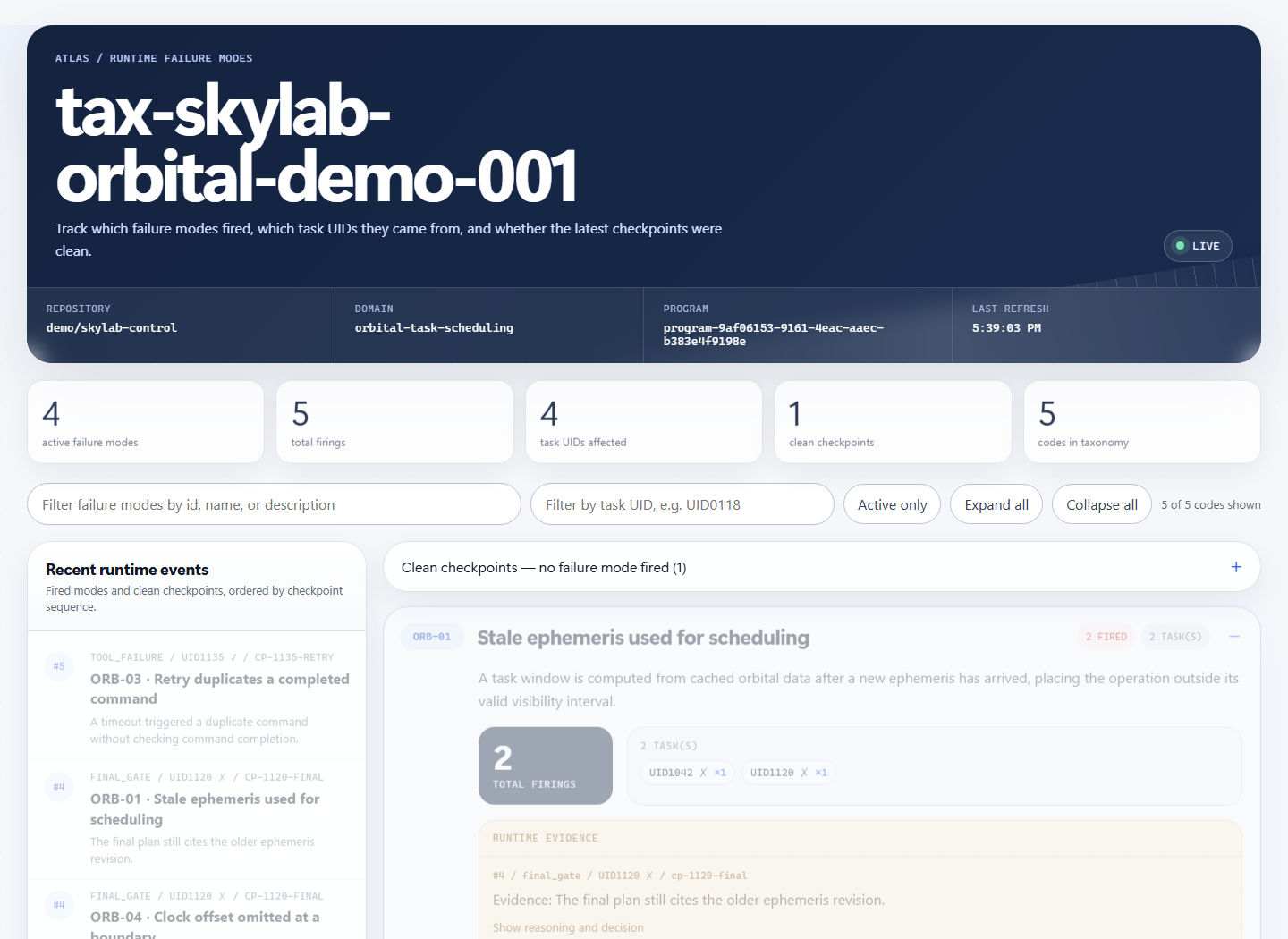
4. What the dashboard shows
Everything the gates record — firings, clean checkpoints, evidence snippets, and per-task UID filters — is browsable live:
5. What learning produces
At session end, one canonical trace is recorded. After enough traces accumulate, generation (or refinement) proposes a taxonomy specialized to the observed failures — a normal stored record that future runs can inherit:
{
  "taxonomy_id": "tax-skylab-orbital-demo-001",
  "repo": "demo/skylab-control",
  "domain": "orbital-task-scheduling",
  "codes": [
    {
      "id": "ORB-01",
      "name": "Stale ephemeris used for scheduling",
      "description": "A task window is computed from cached orbital data after a new ephemeris has arrived, placing the operation outside its valid visibility interval.",
      "category": "Runtime"
    },
    {
      "id": "ORB-02",
      "name": "Resource lock released before handoff",
      "description": "Exclusive antenna or compute capacity is released before the downstream task confirms ownership, allowing overlapping operations to claim the same resource.",
      "category": "Coordination"
    }
  ]
}
Inherit it in a later run with --inherit tax-skylab-orbital-demo-001.
Where to go next
- The lifecycle behind steps 4–5: TRACES_AND_LEARNING.md
- The gate and reflection contract for harness authors: INTEGRATION.md
- Dashboard details and UID filtering: DASHBOARD.md